 Waida Studio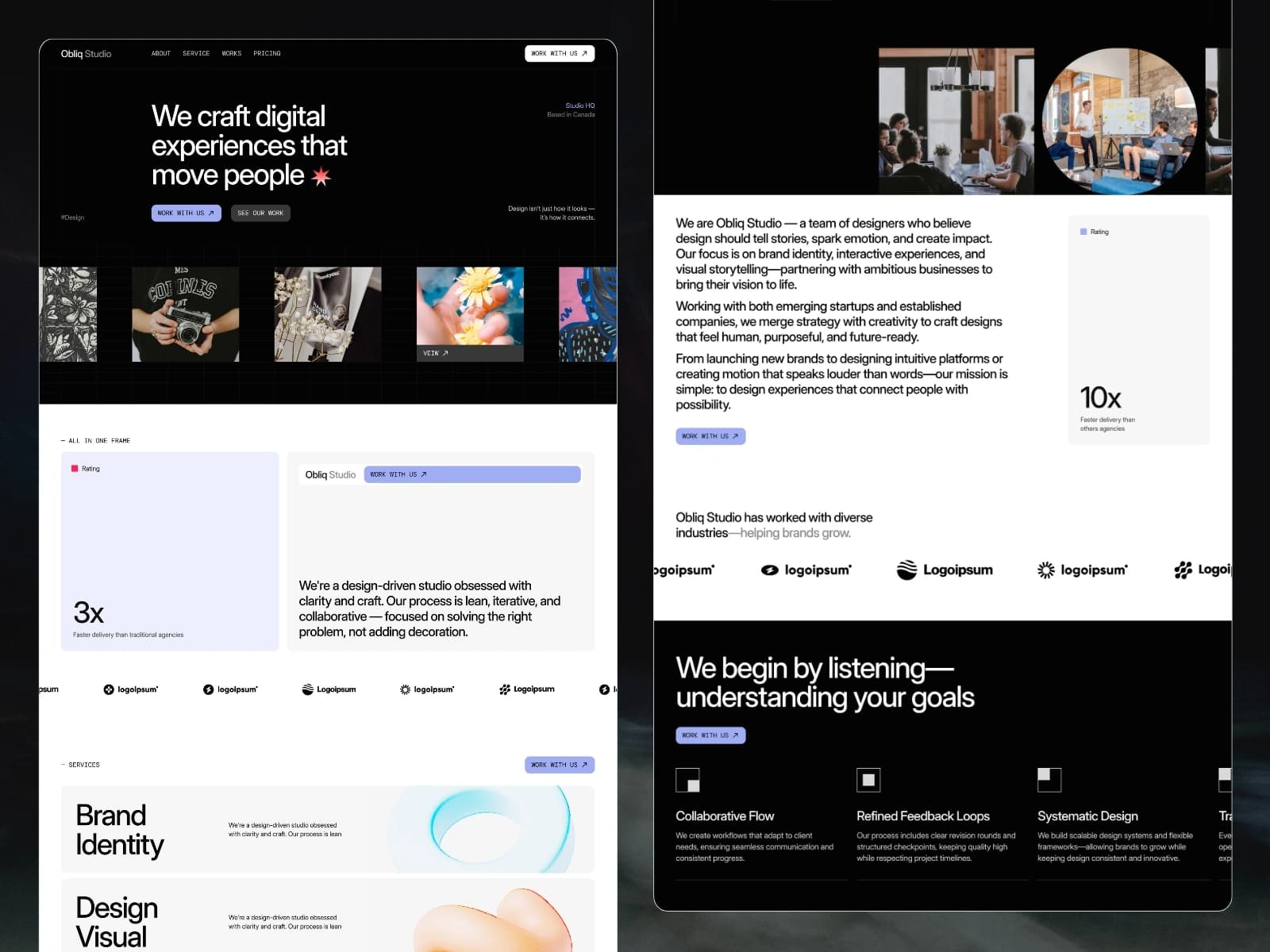
Obliq Studio is a Next.js 16 template for design studios, creative agencies, branding consultancies, freelance designers and portfolio-led teams — anyone who has to show the work, explain the thinking behind it, hire for it, and sell a package at the end. Built on the App Router with React 19 and TypeScript in strict mode, it ships 21 page templates covering 47 fully static routes, with case studies, articles, services and job postings driven by MDX files and the plans, products and categories by JSON. No CMS or backend required.
Whether you run a brand identity studio, a UI/UX practice, a motion and visual design shop or a one-person portfolio, Obliq Studio gives you every page the case needs — a work index with eight case studies, five service pages, a nine-article journal, a careers board, and a two-plan storefront with a working basket. Content lives in files: add a case study and it appears in the work index, in the home page marquee and at its own URL without touching a component.
Tech Stack
Next.js 16 — App Router, every route prerendered to static HTML at build time
React 19 — server components by default, small client islands for the basket and the buy box
TypeScript — strict mode,
npm run typecheckcleanHand-crafted CSS — one plain stylesheet driven by CSS custom properties, no utility framework and no build-time CSS pipeline
Self-hosted webfonts — Inter Display and DM Mono as woff2, no third-party font requests at runtime
MDX content layer — gray-matter frontmatter with a prose parser that renders into the design's own markup
Working basket — localStorage-backed React state shared by every surface that prints it
Zero animation libraries — the scroll reveals, marquees, scroll-linked sections, counters, tab sets and pointer parallax are one TypeScript file
Included Pages and Templates
Core pages
Home with a background film, a project marquee, a scroll-linked work rail, an animated services list, two slot-machine counters, a logo ticker and a seven-row FAQ
About the studio with a second film, a pointer-driven parallax panel and the team
Contact with an enquiry form and studio details
Work
Work index with 8 case study pages: tagline, client sheet, industry, year, a photo set and a four-part write-up
Services
5 service pages, each with a hero, four labelled sections and the design's photo plates
Journal
Blog index and 9 full-length articles with published date, reading time, author and an introduction block
Careers
Careers board with department tabs and 6 job postings: position, location, type, responsibilities, requirements, benefits and how to apply
Storefront
Pricing grid with Monthly and Project tabs
2 buy pages, each with a duration toggle that moves the price, and 2 category pages
Cart drawer, checkout, PayPal checkout and order confirmation
Utility pages
Style guide, licenses, changelog, 401 password-protected page and a 404 page
21 page templates. 47 static routes.
Easy Content Editing
Everything you change lives in src/content/. Edit a file, rebuild, done.
src/content/blog/*.mdx— the 9 articles: date, reading time, author, card and hero images, introduction and bodysrc/content/works/*.mdx— the 8 case studies: location, country, design lead, website, industry, work, year, and a four-section write-upsrc/content/services/*.mdx— the 5 services: card copy, hero and four labelled sectionssrc/content/careers/*.mdx— the 6 postings: position, location, type and the posting itselfsrc/content/plans.json— the 4 pricing cards: price, billing period, feature columns and the classes the design gives each cardsrc/content/products.json— the 2 buy pages: price table, feature list and what the basket storessrc/content/categories.json— the 2 category pages
Each file states its own order, so the sequence the design was built around lives with the content instead of in a separate index. Add a case study and it appears in the work index, the home page marquee and its own route — with no component to touch.
Body copy is Markdown: section headings, paragraphs and lists. A prose parser places each block inside the design's own markup, so the words stay editable and the layout stays exact.
Theming is one file. Every brand colour, font, spacing step and type size is a CSS custom property in the :root block at the top of public/assets/css/styles.css. Change a value there and it propagates across every page.
Performance and SEO
Every route prerendered as static HTML, ready for a CDN
Per-page title, description and Open Graph and Twitter card metadata
Absolute share-image URLs so link previews resolve
Self-hosted fonts with
font-display: swapand zero third-party requestsBackground films are
preload="none"with poster frames, so nothing downloads until a visitor reaches themLazy-loaded imagery with responsive
srcseton every photographSemantic markup with one H1 per page, real buttons, a skip link and landmarks
Keyboard-reachable navigation panel, tab sets, accordion and price toggle
Full
prefers-reduced-motionsupport, and readable with JavaScript off
Deployment
Deploys to Vercel, Netlify, Cloudflare Pages or any static host. npm run build prerenders every route; there is no server, no database and no API to configure. The basket is browser-side, so it works on a static host as shipped.
What You Get
The complete Next.js 16 project source
21 page templates covering 47 static routes
9 articles, 8 case studies, 5 services and 6 job postings as editable MDX
2 products, 2 categories and 4 pricing cards as JSON, with a working cart, checkout and confirmation flow
The original stylesheet, self-hosted webfonts and three background films
Full HTML documentation
Changelog and third-party license file
Requirements
Node.js 20 or newer
npm 10 or newer, or pnpm, yarn or bun