 Waida Studio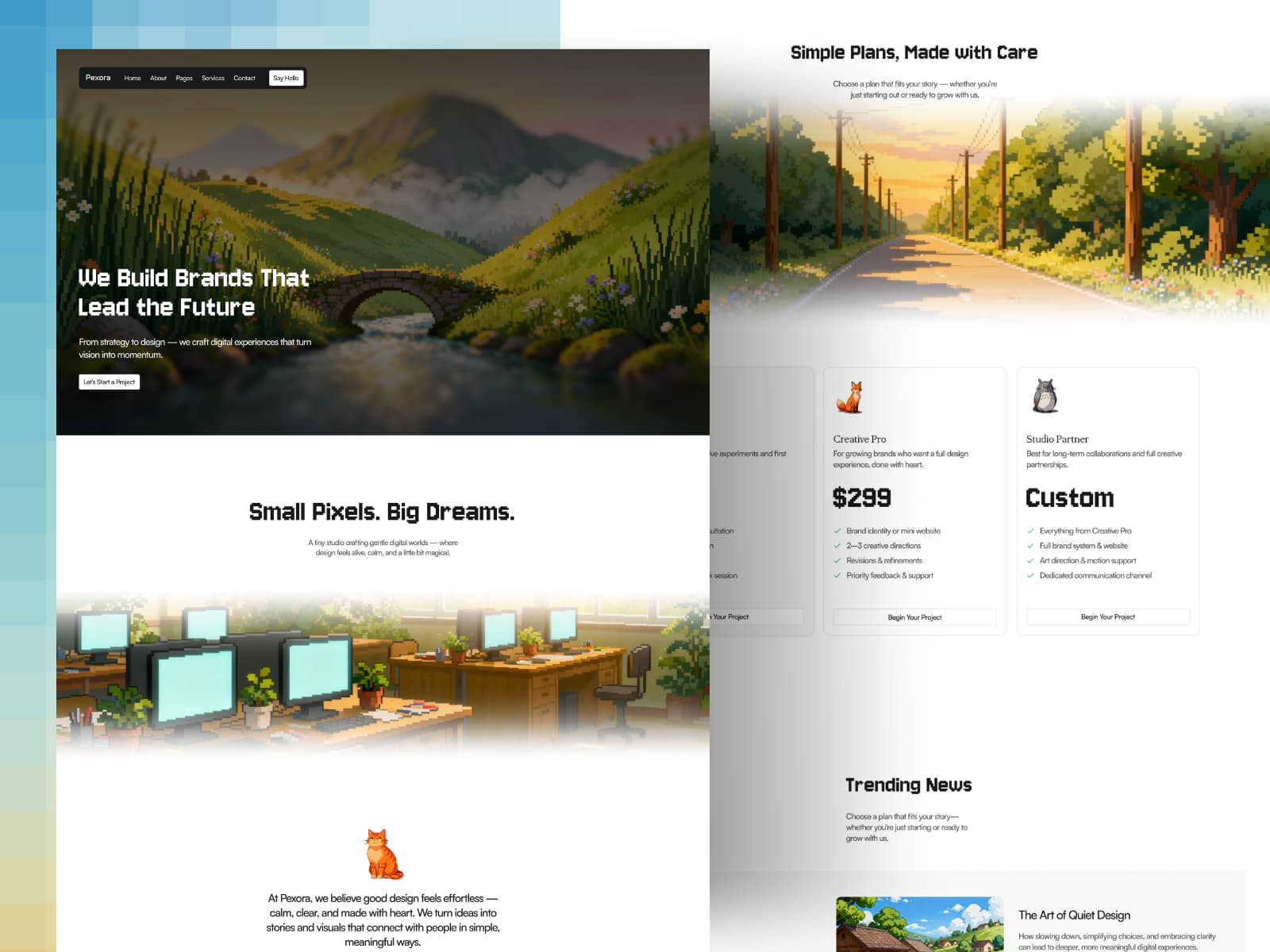
Pexora is a creative studio template for design practices, illustration studios and independent makers who want a site with a personality — and who also want to sell, because its service packages go through a real cart, checkout and order confirmation. Built with Next.js 16, React 19 and TypeScript, it ships 22 page templates covering 32 static routes: a portfolio with three full case studies, a six-article blog with category filter tabs, three priced packages, and every utility page a real site needs. No CMS or backend required.
Written for studios that show the work and name the price. Blocky arcade display type over pixel-art landscapes, lilac, lime and yellow cards dealt across a near-black page, and headlines that flip character by character as you scroll to them. All content lives in MDX files you can edit in any text editor, so you can change every word, price and picture and launch in hours.
Tech Stack
Next.js 16 App Router — every page prerendered to static HTML at build time, so there is no server, no database and no API to configure.
React 19 — the basket, the checkout summaries and the order confirmation are React components reading one store, so every surface that prints the basket agrees at every moment.
TypeScript in strict mode — the content layer is typed end to end, and a malformed article stops the build naming the file.
Hand-crafted CSS — one plain stylesheet driven by CSS custom properties. No utility framework, no CSS-in-JS, no build plugin for the design.
Self-hosted woff2 fonts — Jersey 10, Figtree and EB Garamond ship with the item. No third-party font request at runtime, on any page.
MDX content layer — articles, case studies and packages as files, read at build time with gray-matter.
No animation library — the scroll reveals, the character and line splits, the sliders and the scroll-driven rails are one TypeScript client component over the stylesheet's own values.
Included Pages and Templates
Marketing
Home, with a project slider, a service rail, a pricing row and a testimonial carousel
About, with a scroll-driven card sequence and a team grid
Service, with a sticky step rail
Contact, with a labelled enquiry form and an FAQ accordion
Portfolio and blog
Project index, and three full case studies with their own overview, brief, approach and outcome
Blog archive with category filter tabs, and six full-length articles
Commerce
Pricing, and a plan category page
Three package pages with quantity control and Add to Cart
Checkout, PayPal checkout and order confirmation, all on localStorage
Utility
Style guide, licence, instructions, changelog, privacy policy, terms and conditions, a password-protected 401 page and a 404 page
22 page templates, 32 static routes.
Easy Content Editing
Everything you change lives in one folder, src/content/:
blog/*.mdx — the six articles: title, summary, date, read time, category, thumbnail, banner and body
projects/*.mdx — the three case studies: title, summary, tags, gallery and body
plans/*.mdx — the three packages: name, price, feature list and the copy its own page prints
Copy a file, rename it after the URL you want, and edit it. Its order decides where it falls, and every other surface follows — the archive's category panels, the home page's three-card row, the related strip under each sibling — with no component to touch.
Theming is one file: every colour, font, spacing step and type size is a CSS custom property in the :root block at the top of public/assets/css/styles.css. Change a value there and it propagates across every page.
Performance and SEO
Every route is prerendered as static HTML, so a page is served as a file rather than rendered on request. Per-page titles and descriptions, Open Graph and Twitter cards on all 31 pages. Lazy-loaded imagery with above-the-fold artwork eager, and modern formats at the sizes the layout asks for. Semantic landmarks, a skip link on every page, exactly one H1 per page, and real controls throughout — the tabs, the accordion, the sliders, the cart and every form are buttons a keyboard can reach and a screen reader can name. Every animation stops when the visitor's system asks for reduced motion.
Deployment
npm run build prerenders every page. Deploy to Vercel, Netlify, Cloudflare Pages or any host that runs a Next.js build. There is no server to run and nothing to configure.
What You Get
The full Next.js 16 project source, commented throughout
22 page templates covering 32 static routes
6 articles, 3 case studies and 3 packages as editable MDX
A working cart, checkout and order confirmation on localStorage
Three self-hosted font families, licensed for commercial use
HTML documentation, a changelog and a third-party attributions file
Requirements
Node.js 20 or newer
npm 10 or newer, or pnpm, yarn or bun
A code editor. No design tool, no CMS account and no database.