 Waida Studio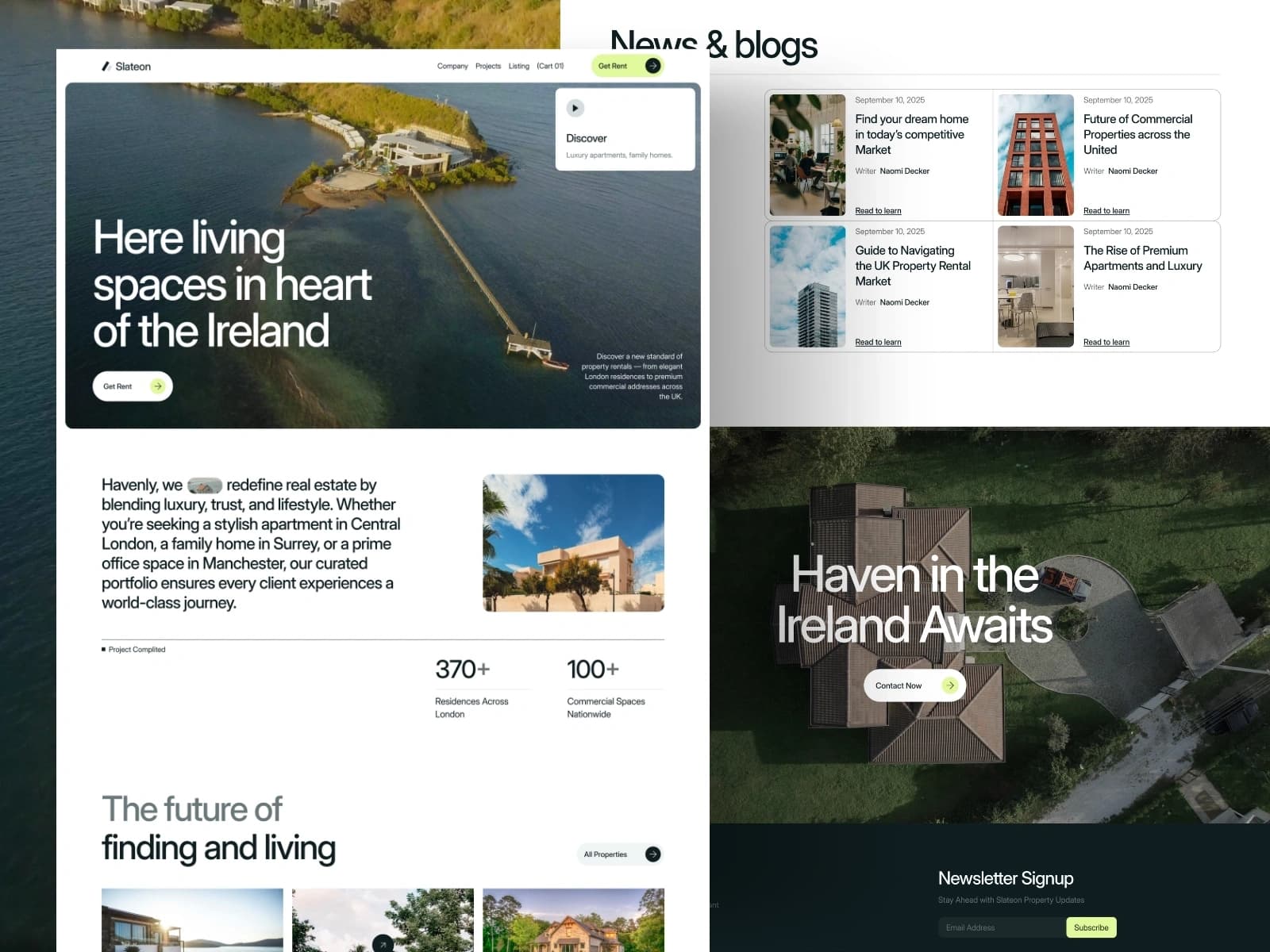
Slateon is a Next.js 16 template for estate agencies, letting agents, property developers and architecture studios — the businesses whose site has to make a building look worth visiting and make the enquiry easy. It ships 20 page templates covering 42 routes: five development case studies, four service pages, a ten-article blog with category tabs, a six-property listing with a working basket and a three-page checkout, For Rent and For Sale category pages that genuinely filter, and every utility page a real site needs. Built on the App Router with React 19 and TypeScript in strict mode, and every page prerenders to static HTML. No CMS or backend required.
If you run a city-centre lettings agency, a residential developer, a commercial property consultancy, a buying agency or an architecture practice, this is the site with the pages already in it. Content lives in JSON or MDX files — add a case study and it appears in the portfolio grid and at its own URL with no component to touch — so you can launch in hours rather than weeks.
Tech Stack
Next.js 16 — App Router, static prerendering for every route
React 19 — server components by default, client components only where state actually lives
TypeScript — strict mode, no
anyin the content layerHand-crafted CSS — the template's own stylesheet driven by CSS custom properties. No utility framework, no CSS-in-JS, no build step beyond Next's own
Self-hosted Inter Display — four WOFF2 weights. No third-party font request at runtime
No animation library — the scroll reveals, the split-text timelines, the carousels, the counters, the ticker and the scroll-linked sections are one TypeScript file that moves classes and custom properties; the CSS does the rest
gray-matter — the only runtime dependency beyond React and Next
Included Pages and Templates
Marketing
Home — a full-screen showreel that opens as you scroll, a project gallery carousel, a listing grid with price, address and size on every card, an animated services list that swaps its photograph as you move down it, slot-machine counters, a quote slider, a video lightbox and an FAQ
Company — the studio, its numbers, its people and a photograph ticker
Contact — an enquiry form and office details
Work and services
Portfolio grid, plus 5 case study pages with a fact panel and two counters
Service list, plus 4 service pages with client, location and year
Property listing
Listing grid, plus 6 property pages with a buy box and a five-row FAQ
For Rent and For Sale category pages, derived from the properties themselves
Slide-out basket, checkout, PayPal checkout and order confirmation
Content
Blog with keyboard-navigable category tabs, plus 10 full-length articles
Utility
Style guide, licences, changelog, password-protected 401 and 404
20 page templates covering 42 routes, every one prerendered as static HTML.
Easy Content Editing
Everything a page prints lives in src/content/. Add a file and it publishes:
blog/*.mdx— the 10 articles: author, date, card and banner photographs, overview, and the bodyprojects/*.mdx— the 5 case studies: the fact panel beside the title, two counters, and three labelled paragraphsproducts.json— the 6 properties: photograph, price, address, size, agent and the values the basket storesservices.json— the 4 services: client, location, year and two promisescategories.json— For Rent and For Sale: the badge and the copy above each filtered gridblog-layout.json— which article fills which slot on the blog page
Bodies are plain Markdown — ## headings, paragraphs, - lists and > pull quotes — placed inside the design's own markup, so the words are yours and the layout stays exact. Each file states its own order, so the arrangement lives with the content.
Re-theming is one file. Every colour, type size, spacing step and radius is a CSS custom property in the :root block of public/assets/css/styles.css.
Performance and SEO
Every route prerenders to static HTML — nothing is rendered on demand
No third-party requests at runtime: no font CDN, no icon CDN, no analytics. The one embed, the video lightbox, loads only after a visitor presses play
Lazy-loaded imagery with responsive
srcsetrungs; above-the-fold artwork eagerThe three background films are
preload="none"behind poster frames, so none of the 16 MB is fetched until someone scrolls to onePer-page title, description and Open Graph and Twitter cards, generated from one shared helper
Semantic HTML with a single
<h1>per page and a heading outline with no gapsSkip link, landmarks, ARIA patterns on the tabs, accordions, carousels and basket drawer, and every control keyboard reachable and screen-reader named
prefers-reduced-motionrespected throughout, and the site is fully readable with JavaScript switched off
Deployment
npm run build produces a fully static site. Deploy it to Vercel, Netlify, Cloudflare Pages, GitHub Pages, S3, or any static host — or run npm run start behind Node 20. No database, no API keys, no environment variables.
What You Get
The complete Next.js 16 project, source included and commented throughout
20 page templates, 42 static routes
A content layer of 15 MDX files and 4 JSON files
A working basket and a three-page checkout in
localStorageFull HTML documentation, a README, a changelog and a third-party licence file
Self-hosted fonts and every image and video the demo uses
Requirements
Node.js 20 or newer
npm 10 or newer (pnpm, yarn and bun also work)
Basic React and TypeScript familiarity to customise components; none needed to edit content